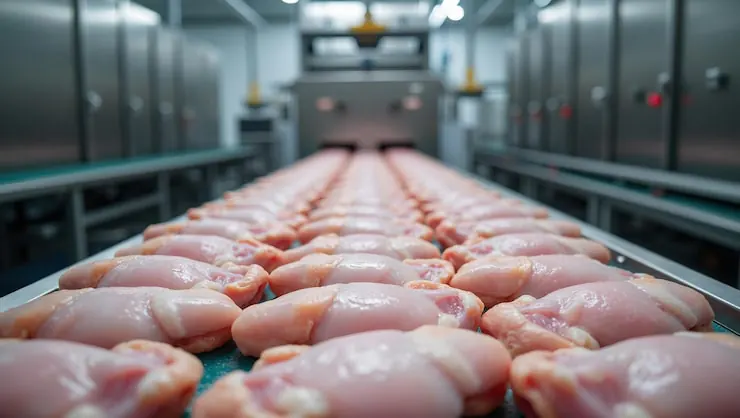
Poultry and Meat Sorters: Applications, Types, and Benefits in Protein Processing
Rotonix Engineering Team7 min
A poultry and meat sorter separates whole birds, cuts, and portions by weight, size, and quality. This guide covers applications, technologies, and measurable benefits.
A poultry and meat sorter is a key machine in protein processing lines that automatically separates whole birds, cuts, and meat portions by weight, size, and quality. This article reviews its applications, technologies, and benefits.
Related Articles
Rotonix
Ready to Automate Your Warehouse?
Don't let sorting errors or product damage undermine your productivity. Get in touch with the Rotonix team today.
Why the protein industry needs sorters
Weight variation in live birds and meat cuts is unavoidable, yet the final pack must carry a uniform, accurate weight. Manual sorting is slow, error-prone, and hygienically challenging; weight and vision sorters solve this with gram-level accuracy.
Uniform packs that match the declared label weight
Pricing and batching based on exact weight
Less direct human contact with product and better hygiene
Higher line speed with less waste and giveaway
Main applications of poultry and meat sorters
1) Weight grading of whole birds
On slaughter lines, birds are divided after evisceration into weight groups for packing, freezing, or fresh sale. Weight sorting machines handle up to 6,000 birds per hour, and modern weighing and transfer machines reach 250 birds per minute.
2) Sorting cuts (legs, breasts, fillets)
Weight sorting of chicken cuts, especially legs and breasts, is one of the most common applications in Iran. These systems typically classify product into 6 to 12 weight grades so every pack carries a defined, uniform weight.
Rotating-tray weight grader suited to chicken cuts and meat portions
3) Quality and defect detection with machine vision
Fillet inspection cameras detect color, shape, and surface defects, combining quality sorting with weight sorting; the result is defective product removed before packing.
4) Batching for packing and freezing
Fixed-weight batching for trays, bags, and IQF freezing is another key application; the goal is the target weight with the fewest pieces and the least giveaway.
Sortation technologies in the meat industry
Weight sorter (load cell): gram-level accuracy, typically ±1 g or better
Vision sorter (camera): size, color, and visual quality control
Combined weight and vision: simultaneous piece-weight and surface-quality control
Rotating-tray grader: suited to wet cuts and meat portions
For small plants, portable grading machines with capacities around 850 to 900 birds per hour and prices near $12,000 to $14,000 are also available on the global market.
Measurable benefits of poultry and meat sorters
Sorting accuracy of 0.5 to 1 gram per piece
Up to 60 percent labor-cost reduction with rotating-tray sorters
Line capacity coverage from 500 to 15,000 birds per hour by configuration
Less giveaway weight and higher saleable yield
How to choose the right poultry and meat sorter
Define the product: whole bird, cut, fillet, or portion
Measure line capacity in birds or kilograms per hour
Require food-grade stainless construction and full washdown capability
Check the number of weight grades and discharge channels
Evaluate integration with packing, freezing, and traceability systems
In the protein industry every gram matters; an accurate sorter turns weight variation from a cost factor into a management tool.
Rotonix Engineering Team
To discuss designing a poultry and meat sortation line, send a , and explore other solutions on the .